Vol. 1 15-7
PROGRAMMING WITH INTEL® AVX-512
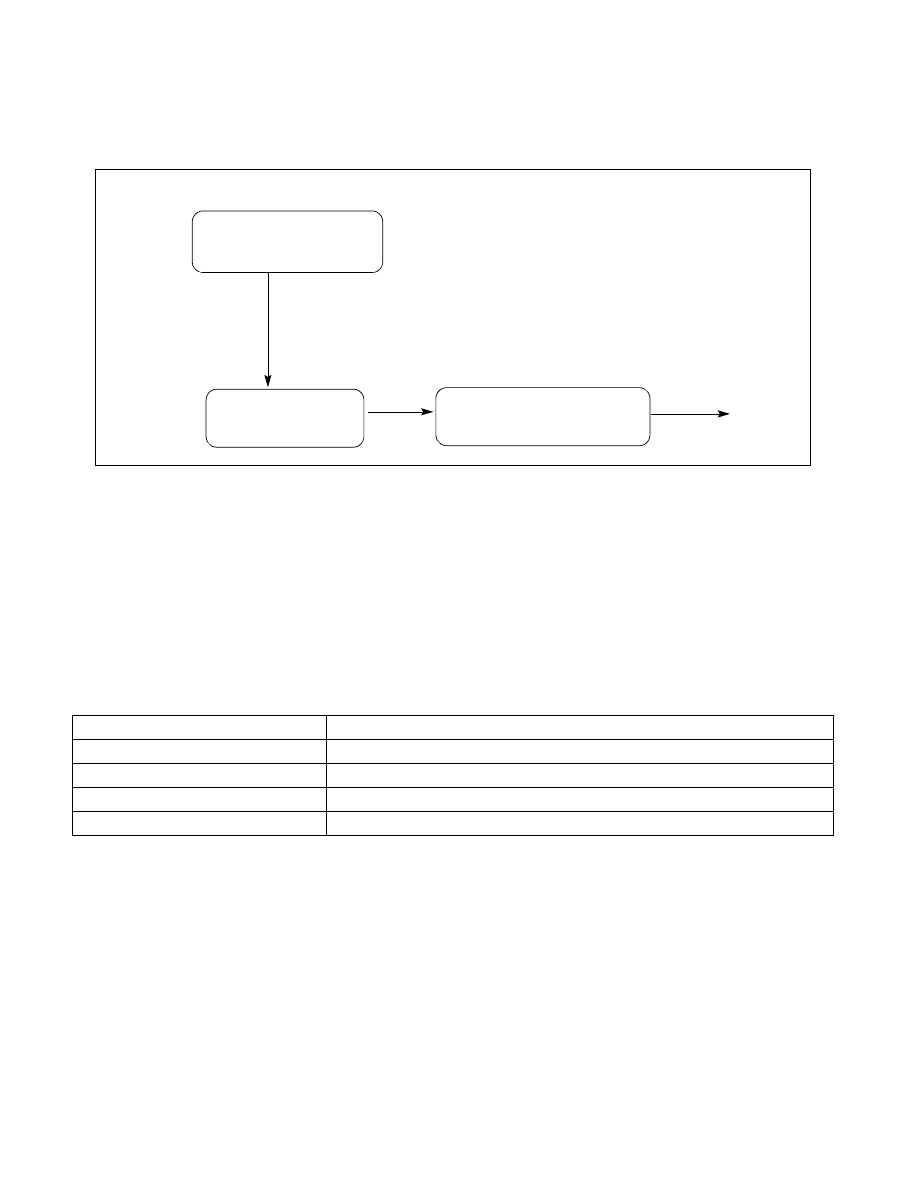
The AVX512VL flag alone is never sufficient to determine a given Intel AVX-512 instruction may be encoded at
vector lengths smaller than 512 bits. Software must use the procedure described in Figure 15-5 and Table 15-2.
To illustrate the procedure described in Figure 15-5 and Table 15-2 for software to use EVEX.256 encoded VPCON-
FLICT, the following sequence is provided. It is strongly recommended this sequence is followed.
1) Detect CPUID.1:ECX.OSXSAVE[bit 27] = 1 (XGETBV enabled for application use).
2) Execute XGETBV and verify that XCR0[7:5] = ‘111b’ (OPMASK state, upper 256-bit of ZMM0-ZMM15 and
ZMM16-ZMM31 state are enabled by OS) and that XCR0[2:1] = ‘11b’ (XMM state and YMM state are enabled by
OS).
3) Verify CPUID.0x7.0:EBX.AVX512F[bit 16] = 1, CPUID.0x7.0:EBX.AVX512CD[bit 28] = 1, and
CPUID.0x7.0:EBX.AVX512VL[bit 31] = 1.
In some specific cases, AVX512VL may only support EVEX.256 encoding but not EVEX.128. These cases are listed
in Table 15-3.
Figure 15-5. Procedural Flow for Detection of Intel AVX-512 Instructions Operating at Vector Lengths < 512
Table 15-2. Feature flag Collection Required of 256/128 Bit Vector Lengths for Each Instruction Group
Usage of 256/128 Vector Lengths
Feature Flag Collection to Verify
AVX512F
AVX512F & AVX512VL
AVX512CD
AVX512F & AVX512CD & AVX512VL
AVX512DQ
AVX512F &
AVX512DQ & AVX512VL
AVX512BW
AVX512F &
AVX512BW & AVX512VL
Implied HW support for
Check enabled state in
XCR0 via XGETBV
Check applicable collection of
CPUID flags listed in
Table 2-2
Check feature flag
CPUID.1H:ECX.OXSAVE = 1?
OS provides processor
extended state management
States
ok to use
XSAVE, XRSTOR, XGETBV, XCR0
enabled
Instructions
Yes
YMM,ZMM
Opmask,